


Depression Support
Compassionate, evidence-based resources and guidance to help you navigate depression with resilience and hope.

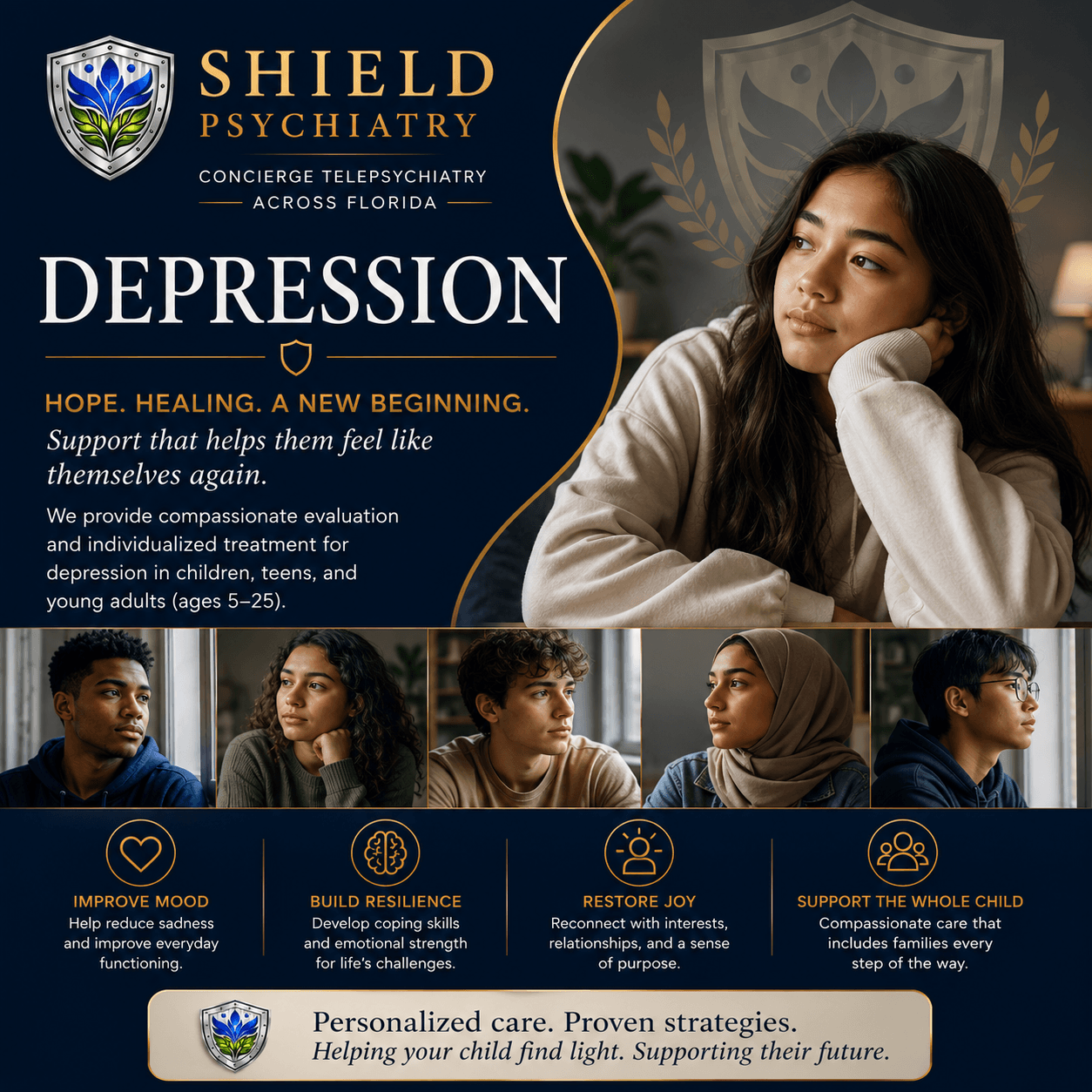
Depression in Children, Teens & Young Adults in Florida
Depression in young people often looks nothing like adult depression — it shows up as irritability, exhaustion, school refusal, loss of motivation, or a heaviness families can't quite name. At SHIELD Psychiatry, Dr. Akers provides comprehensive psychiatric evaluation, CBT-informed care, and medication management for children, teens, and young adults ages 5–25 across Florida.
Understanding Depression · Signs by Age · Florida Telehealth
What Depression Looks Like in Children, Teens & Young Adults
Depression is more than sadness — in young people it often presents as irritability, exhaustion, withdrawal, or a loss of interest that families notice long before the child can name it.
More Than Sadness
Many families don't recognize depression in their child or teen because it doesn't look like what they expected. Instead of crying or saying "I'm sad," young people with depression may become irritable, angry, or shut down. They may stop caring about things they used to love, struggle to get out of bed, fall behind in school, or seem like a different person entirely.
Depression in children and teens is often accompanied by anxiety, ADHD, sleep problems, or somatic symptoms like chronic headaches and stomachaches — making it easy to miss or misattribute to other causes.
At SHIELD Psychiatry, Dr. Akers conducts a comprehensive psychiatric evaluation to clarify what's driving the symptoms — distinguishing depression from grief, burnout, ADHD inattention, anxiety, or other conditions — and building an individualized care plan.
CBT · Medication Management · Treatment Planning · Florida Telehealth
Depression Treatment at SHIELD Psychiatry
Treatment is individualized — starting with diagnostic clarity, then building a care plan that may include CBT, behavioral activation, medication management, sleep support, and school coordination.
Comprehensive, Integrated Care
Depression treatment at SHIELD Psychiatry begins with a thorough psychiatric evaluation to clarify diagnosis, identify co-occurring conditions, and understand how depression is affecting your child's daily functioning at home, school, and with peers.
Dr. Akers provides CBT-informed care and behavioral activation integrated within psychiatric visits — teaching practical skills for identifying cognitive distortions, challenging unhelpful thought patterns, scheduling pleasurable activities, and building routines that support mood recovery.
When medication is clinically indicated, SSRI and SNRI management is offered with careful titration, close monitoring for side effects and response, and shared decision-making with the family at every step.
What Treatment May Include
- Psychiatric Evaluation — DSM-5-TR diagnostic formulation and individualized treatment plan
- CBT & Behavioral Activation — Thought records, activity scheduling, and mood tracking
- Safety Planning — Personalized plan for suicidal thoughts or self-harm urges when clinically indicated
- Medication Management — SSRI/SNRI with titration, monitoring, and family education
- Sleep Support — CBT-I-informed sleep strategies integrated into treatment
- School Coordination — IEP, 504, school letters, and attendance support
- Family Guidance — Psychoeducation and coaching for caregivers
- Faith-Integrated Care — Available upon family request
What to Expect — Treatment Timeline
1
Evaluation & Safety Plan
Comprehensive psychiatric evaluation, diagnostic formulation, safety planning if needed, and first steps agreed upon with the family.
2–4
CBT Skills & Behavioral Activation
Begin CBT skill-building, activity scheduling, sleep plan, and school support letters if needed. Mood and functioning tracked.
5–8
Medication Review & Adjustment
If medication was started, review response and tolerability. Adjust dose if needed. Continue skills work and school collaboration.
Maintenance & Relapse Prevention
Consolidate gains, build relapse prevention skills, taper frequency of visits as functioning improves, and plan for transitions.
Frequently Asked Questions · Depression Care · Florida
Depression Treatment FAQs
- Does SHIELD Psychiatry provide therapy for depression? Yes. Dr. Akers provides CBT-informed care and behavioral activation integrated within psychiatric visits. For children or teens who need more intensive weekly therapy, Dr. Akers can provide referrals to therapists and coordinate care as part of a collaborative treatment team.
- Is medication always part of depression treatment? No. Treatment begins with a thorough evaluation and CBT-informed skills work. Medication is considered when symptoms are moderate to severe, not responding to therapy alone, or when the family and Dr. Akers agree it fits the clinical picture. When medication is used, it is carefully titrated and monitored.
- Can you coordinate with my child's school? Yes. SHIELD Psychiatry provides letters for IEP and 504 accommodations, school attendance support documentation, and collaboration with school counselors and teachers when clinically appropriate and authorized.
- Does SHIELD Psychiatry accept insurance for depression treatment? Yes. Insurance-based visits are available through Headway for Aetna Florida, Cigna Florida, SmartHealth Ascension Florida, and Carelon Behavioral Health Florida. Self-pay appointments are also available at $349 for an initial evaluation and $179 for follow-up visits.
- What if my child is having thoughts of suicide? Safety planning is included as part of the comprehensive psychiatric evaluation when clinically indicated. For immediate safety concerns, call 911, go to the nearest emergency room, or call/text 988 (Suicide & Crisis Lifeline). SHIELD Psychiatry is not an emergency crisis service.
- Where in Florida is depression treatment available? SHIELD Psychiatry provides telehealth depression treatment for families across Florida, including Lutz, Tampa, Wesley Chapel, Orlando, Jacksonville, Miami, Sarasota, Naples, Boca Raton, Palm Beach, and surrounding areas.
Depression FAQ & Resources
-
Depression is a mental health disorder that causes persistent feelings of sadness, hopelessness, and loss of interest in activities. It affects how you think, feel, and function in daily life, often leading to fatigue, sleep disturbances, difficulty concentrating, and physical symptoms like body aches or appetite changes.
-
✔ Major Depressive Disorder (MDD) – Persistent sadness, loss of interest, and difficulty functioning for at least two weeks
✔ Persistent Depressive Disorder (Dysthymia) – Chronic, lower-level depression lasting two years or more
✔ Bipolar Depression – Depression that occurs as part of bipolar disorder, alternating with manic episodes
✔ Seasonal Affective Disorder (SAD) – Depression that follows a seasonal pattern, usually worse in winter months
✔ Postpartum Depression – Depression that occurs after childbirth due to hormonal and emotional changes
✔ Situational Depression – Short-term depression triggered by stressful life events, grief, or major changes -
Depression is a complex condition caused by a combination of:
✔ Brain Chemistry & Genetics – Imbalances in neurotransmitters (serotonin, dopamine) and family history of depression
✔ Chronic Stress & Trauma – Long-term stress, abuse, or unresolved trauma can contribute to depressive symptoms
✔ Medical Conditions & Medications – Thyroid disorders, chronic pain, or medications like beta-blockers can trigger depression
✔ Lifestyle & Environmental Factors – Poor diet, lack of exercise, and social isolation can worsen symptoms -
Depression is diagnosed through a comprehensive psychiatric evaluation, including:
✔ A discussion of symptoms and how they impact daily life
✔ A review of medical and family history
✔ Standardized depression screening toolsAt SHIELD Psychiatry, we offer telehealth-based depression assessments to provide accurate diagnosis and personalized treatment plans.
-
✔ Cognitive Behavioral Therapy (CBT) – A structured therapy that helps identify and change negative thought patterns
✔ Medication Management – Antidepressants such as SSRIs, SNRIs, or atypical antidepressants may help rebalance brain chemistry
✔ Lifestyle Adjustments – Regular exercise, healthy sleep habits, and nutrition can improve mood
✔ Mindfulness & Relaxation Techniques – Meditation, deep breathing, and stress-reduction exercises
✔ Support Groups & Psychotherapy – Connecting with others can provide emotional support and encouragement -
Yes! Many people manage depression effectively without medication by using therapy, lifestyle modifications, and mindfulness techniques. However, for moderate to severe depression, a combination of therapy and medication is often the most effective treatment.
-
✔ Encourage professional help – Therapy and treatment can provide relief and long-term improvement
✔ Stay connected – Isolation worsens depression, so maintain supportive relationships
✔ Create small, achievable goals – Accomplishing small tasks can build motivation
✔ Practice self-care – Prioritize sleep, nutrition, and physical activity
✔ Avoid alcohol & substance use – These can worsen depressive symptoms -
You can schedule a depression evaluation or therapy session by filling out our online form or contacting us directly. Our telehealth services make it easy to receive expert mental health care from the comfort of your home.
Trusted ADHD & Mental Health Resources
Curated organizations, books, and apps families can rely on.
Trusted Mental Health Organizations
-
National Alliance on Mental Illness (NAMI)
Education, peer programs, and helpline for individuals and families.
-
American Psychological Association (APA)
Evidence-based articles, therapist locator, and practice guidance.
-
Depression & Bipolar Support Alliance (DBSA)
Peer-led support groups, wellness tools, and education for mood disorders.
Books on Depression & Recovery
-
Feeling Good: The New Mood Therapy — David D. Burns, MD
CBT-based self-help with actionable thought records and exercises.
-
The Upward Spiral — Alex Korb, PhD
Neuroscience-informed micro-habits to nudge mood and motivation.
-
Lost Connections — Johann Hari
Explores social/contextual drivers; a discussion starter for care plans.
Top-Rated Mental Health Apps
-
Moodfit
Mood tracking, goals, and coping tools to build routines.
-
Woebot
Daily CBT micro-coaching via conversational check-ins.
-
Happify
Evidence-informed activities targeting resilience and positive affect.
-
Calm
Meditation, sleep stories, and stress reduction modules.