
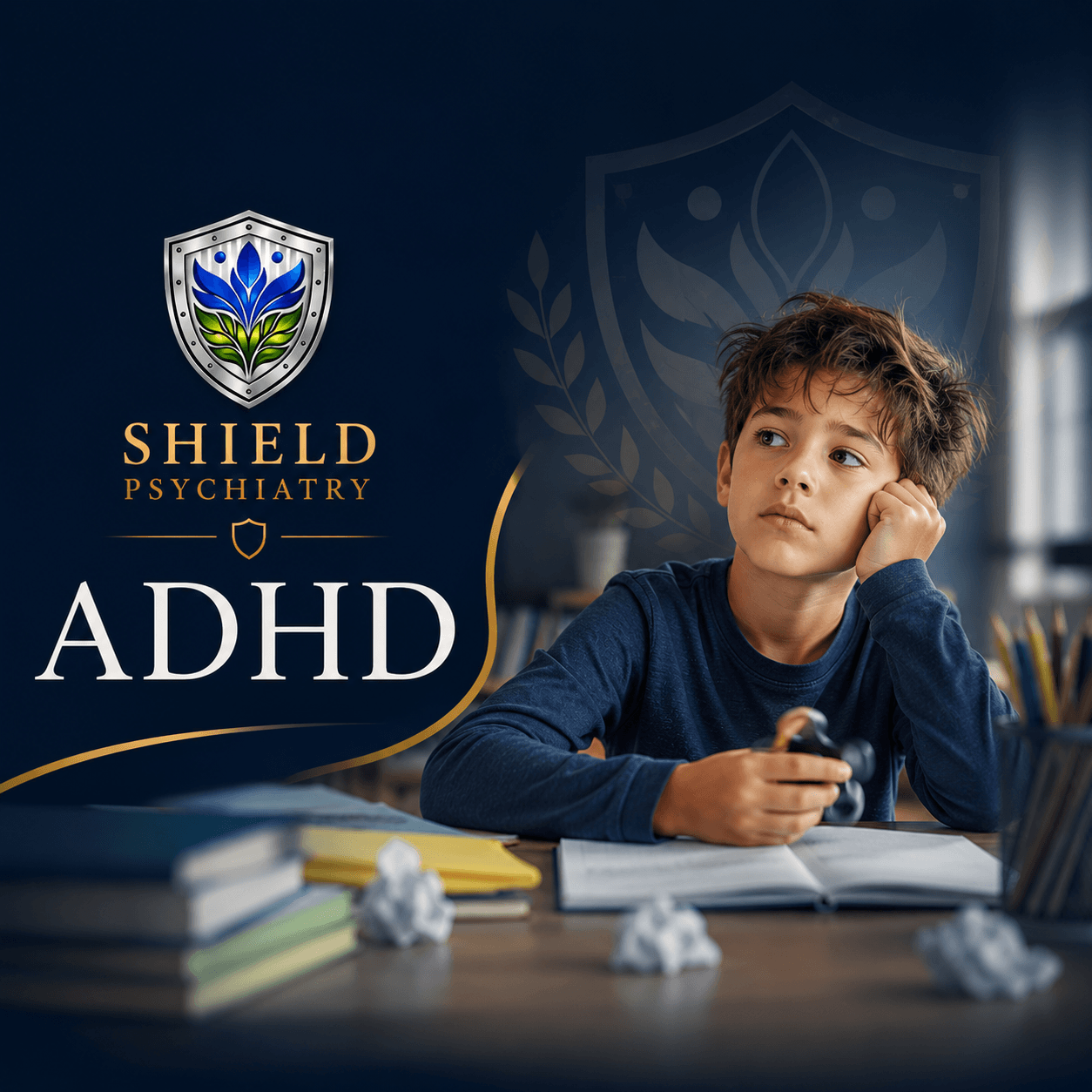
ADHD in Children, Teens & Young Adults in Florida
Comprehensive ADHD evaluation and treatment for ages 5–25 — via telehealth across Tampa Bay, Lutz, and all of Florida.
ADHD affects focus, impulse control, and executive functioning in children and teens in ways that impact school performance, relationships, and self-esteem. At SHIELD Psychiatry, we go beyond a checklist — combining a full developmental interview, parent and teacher rating scales, and FDA-cleared QbCheck™ objective testing to deliver an accurate diagnosis and a personalized treatment plan that fits your child's life.
ADHD Evaluation · QbCheck™ Testing · Executive Function Support · Florida Telehealth
ADHD Evaluation & Treatment for Children, Teens & Young Adults in Florida
Comprehensive ADHD care for ages 5–25, including clinical evaluation, QbCheck™ objective testing when appropriate, parent coaching, school and college support, executive function strategies, and ADHD medication management when clinically indicated.
What Is ADHD in Children, Teens & Young Adults?
Attention-deficit/hyperactivity disorder, commonly called ADHD, is a neurodevelopmental condition that can affect attention, impulse control, activity level, emotional regulation, time management, organization, task initiation, school performance, friendships, self-esteem, and daily routines. In children and teens, ADHD may look like distractibility, hyperactivity, unfinished work, emotional outbursts, procrastination, disorganization, forgetfulness, low frustration tolerance, or difficulty following multi-step directions. In young adults, ADHD may show up as time blindness, college stress, difficulty starting tasks, missed deadlines, inconsistent routines, and executive function barriers.
Clinical note: QbCheck™ may provide objective data about attention, activity, and impulsivity for patients age 6 and older when clinically appropriate. It supports the ADHD evaluation process but does not replace a comprehensive psychiatric evaluation, developmental history, rating scales, school feedback, medical review, or clinical judgment.
Common Signs of ADHD by Age Group
- Ages 5–12: distractibility, hyperactivity, impulsive behavior, trouble sitting still, difficulty following directions, losing items, interrupting, emotional outbursts, bedtime struggles, and school behavior concerns
- Ages 13–18: disorganization, unfinished assignments, procrastination, declining grades, emotional reactivity, difficulty planning, poor time management, test anxiety, sleep disruption, and conflict around schoolwork
- Ages 19–25: executive function barriers in college or work, missed deadlines, time blindness, task initiation difficulty, inconsistent routines, low motivation, poor follow-through, and transition stress
Our ADHD Evaluation & Treatment Approach in Florida
- Comprehensive psychiatric intake: developmental history, medical history, school history, family context, functional impairment, symptom rating scales, and review of safety concerns
- QbCheck™ objective ADHD testing: telehealth-compatible ADHD testing for ages 6+ when clinically appropriate, used alongside rating scales and clinical assessment
- Differential diagnosis review: careful evaluation of ADHD versus anxiety, depression, trauma stress, autism-related needs, sleep disorders, learning differences, and environmental stressors
- Strengths-based treatment planning: home routines, school support, parent coaching, executive function strategies, sleep support, therapy collaboration, and practical systems that fit real life
- Medication management when clinically appropriate: shared decision-making, education, careful titration, stimulant and non-stimulant options, side effect monitoring, and functional goal tracking
ADHD at a Glance: Core Areas of Impact
Planners, visual systems, checklists, timers, reminders, and task breakdown can reduce overwhelm and help children, teens, and young adults build momentum.
ADHD documentation and functional recommendations may support IEP, Section 504, college accommodation, extended time, chunking, movement break, and executive function discussions.
QbCheck™ may help track attention, activity, and impulsivity patterns as part of ADHD evaluation or medication monitoring when clinically appropriate.
Therapy-informed strategies may support frustration tolerance, cognitive flexibility, family communication, peer relationships, and follow-through.
ADHD Evaluation & Treatment Across Florida by Telehealth
ADHD evaluation and treatment support is available through secure telehealth for families across Florida, including Lutz, Tampa, Wesley Chapel, Land O’ Lakes, Odessa, Westchase, Carrollwood, South Tampa, St. Petersburg, Clearwater, Orlando, Winter Park, Windermere, Jacksonville, Miami, Coral Gables, Boca Raton, Weston, Palm Beach, Sarasota, Naples, and surrounding areas.
Frequently Asked Questions About ADHD in Children, Teens & Young Adults
- Is ADHD just “bad behavior” or poor parenting? No. ADHD is a neurodevelopmental condition. Behavior that looks like laziness, defiance, or poor motivation may reflect executive function difficulty, emotional regulation challenges, anxiety, sleep problems, or another contributing factor.
- Do you always recommend medication for ADHD? No. ADHD treatment planning is individualized. Care may include skills, structure, parent coaching, school support, sleep strategies, therapy-informed care, and medication management when clinically appropriate.
- Do you coordinate with schools for ADHD accommodations? Yes. With appropriate consent and clinical indication, documentation and functional recommendations may support IEP, Section 504, or college accommodation discussions. Final eligibility is determined by the school or institution.
- Do you offer objective ADHD testing? Yes. QbCheck™ may be used for patients age 6 and older when appropriate. It provides objective data related to attention, activity, and impulsivity but does not replace a full clinical evaluation.
- Can ADHD occur with anxiety, depression, autism, or sleep problems? Yes. ADHD can co-occur with anxiety, depression, autism spectrum disorder, insomnia, learning differences, emotional regulation concerns, and executive function challenges.
- Can you see my child by telehealth outside Lutz or Tampa? Yes. SHIELD Psychiatry provides ADHD evaluation and treatment through secure telehealth across Florida.
ADHD Resources · Executive Function · School Support · Parent Tools
ADHD Resources for Parents, Teens, Young Adults & Clinicians
A curated ADHD resource library for families and providers looking for ADHD education, executive function tools, parent strategies, teen and college ADHD support, school accommodation guidance, IEP and 504 planning resources, ADHD apps, body doubling tools, sleep support, and evidence-informed clinical references.
These resources may be helpful for children, teens, young adults, parents, caregivers, and clinicians navigating ADHD symptoms, inattention, impulsivity, emotional dysregulation, executive functioning difficulties, school struggles, college transitions, time management, task initiation, sleep problems, anxiety, depression, and medication questions. SHIELD Psychiatry provides ADHD evaluation, QbCheck objective testing when clinically appropriate, parent coaching, school and college support, and medication management for ages 5–25 across Florida by telehealth.
For Parents of Children & Teens with ADHD
Parent ADHD resources can help caregivers understand executive function, emotional regulation, school accommodations, homework struggles, morning routines, sleep problems, and the difference between “won’t” and “can’t yet.”
Organizations, Education & School Support
These organizations provide ADHD education, parent tools, school resources, advocacy guidance, and support for ADHD with learning differences, anxiety, depression, and behavioral concerns.
-
CHADD — Children and Adults with ADHD
National ADHD organization with evidence-informed education, parent training, local support, advocacy resources, ADHD toolkits, and information for children, teens, adults, educators, and clinicians.
-
Understood.org
Parent-friendly ADHD and learning differences resource with practical guidance on IEPs, 504 plans, school supports, executive function, homework struggles, and emotional regulation.
-
ADDitude Magazine
ADHD education, expert articles, webinars, symptom checklists, family strategies, school tools, and practical tips for ADHD across childhood, adolescence, college, and adulthood.
-
NAMI — National Alliance on Mental Illness
Family education, peer programs, mental health resources, and support for ADHD with co-occurring anxiety, depression, mood symptoms, family stress, or safety concerns.
Books for Parents: Executive Function, ADHD Understanding & Family Systems
These books are useful for parents who want practical ADHD strategies for organization, emotional regulation, routines, school follow-through, and family communication.
-
Smart but Scattered — Peg Dawson & Richard Guare
Executive function guide for parents of children and teens with ADHD, with checklists, skill-building exercises, routines, and practical home and school strategies.
-
Driven to Distraction — Edward Hallowell & John Ratey
Classic ADHD overview with clinical examples and a strengths-based framework for understanding ADHD from childhood through adulthood.
-
The ADHD Effect on Marriage — Melissa Orlov
Communication and systems-based relationship resource for couples and families affected by adult ADHD, executive function strain, emotional reactivity, and household stress.
For Teens, College Students & Young Adults with ADHD
Teen and young adult ADHD support often focuses on time blindness, procrastination, task initiation, motivation, emotional regulation, sleep, college transition, self-advocacy, and building systems that work in real life.
Education, Self-Advocacy & Peer Support
These resources can help teens and young adults understand ADHD, build self-advocacy language, and find support when ADHD overlaps with anxiety, depression, mood symptoms, or stress.
-
ADDitude Magazine — Teen & Young Adult ADHD Resources
ADHD articles and webinars for teens, college students, and adults covering study skills, time management, relationships, medication questions, organization, and self-advocacy.
-
DBSA — Depression & Bipolar Support Alliance
Peer-led support groups, wellness tools, and education for young adults managing ADHD alongside depression, bipolar disorder, anxiety, mood changes, or emotional dysregulation.
-
CDC ADHD Information
Public health information on ADHD symptoms, diagnosis, treatment, data, classroom resources, and ADHD across childhood and adulthood.
Apps for ADHD Management, Focus, Planning, Sleep & Emotional Regulation
These tools may help with body doubling, visual planning, routines, mood check-ins, anxiety support, sleep routines, and stress reduction between appointments.
-
Focusmate
Virtual body-doubling platform that pairs users with an accountability partner for structured work, studying, task initiation, and follow-through.
-
Tiimo
Visual daily planner designed for different neurotypes, including ADHD and autism, using icons, routines, reminders, and visual time supports.
-
Woebot Health
Digital mental health tools using conversational check-ins and CBT-informed skill support for stress, mood, emotional regulation, and anxiety-related concerns.
-
Calm
Meditation, sleep stories, breathing practices, and stress reduction tools that may support bedtime routines, racing thoughts, sleep onset, and anxiety.
For Clinicians, Pediatric Providers & Mental Health Professionals
Clinician ADHD resources support evidence-informed evaluation, rating scale interpretation, treatment planning, comorbidity assessment, school collaboration, medication monitoring, and developmentally appropriate care for children, adolescents, and young adults.
Clinical Guidelines, Professional Education & ADHD Reference Resources
These resources are helpful for ADHD diagnostic evaluation, pediatric ADHD treatment planning, medication monitoring, behavioral supports, school coordination, and co-occurring anxiety, depression, autism, sleep, or learning concerns.
-
American Academy of Pediatrics — ADHD Clinical Practice Guideline
Pediatric ADHD clinical guideline for diagnosis, evaluation, and treatment of ADHD in children and adolescents.
-
AACAP ADHD Resource Center
ADHD education and clinical resources from child and adolescent psychiatry, including information for families and professionals.
-
CHADD — Professional Resources
Clinical training, ADHD webinars, professional education, and resources for providers supporting ADHD across the lifespan.
-
CDC ADHD Resources
ADHD public health information, materials, classroom resources, diagnosis information, treatment information, and data resources for families and professionals.
Books for Clinicians & Providers
These titles may be useful for clinicians thinking about ADHD through executive function, motivation, mood, behavior, relationships, and contextual stressors.
-
Driven to Distraction — Edward Hallowell & John Ratey
Foundational ADHD clinical overview with case examples and a strengths-based model useful for patient education and provider reflection.
-
The Upward Spiral — Alex Korb
Neuroscience-informed habits and mood-support strategies that may be useful when ADHD overlaps with anxiety, depression, motivation challenges, and emotional dysregulation.
-
Lost Connections — Johann Hari
Contextual mental health book that may be useful as a discussion starter around isolation, meaning, stress, motivation, and social determinants in broader treatment planning.
ADHD Frequently Asked Questions
-
ADHD is a neurodevelopmental condition that affects focus, impulse control, and hyperactivity. It can impact school, work, relationships, and daily life, but with the right strategies and treatment, individuals with ADHD can thrive.
-
ADHD symptoms vary by individual but generally fall into three categories:
✔ Inattention – Difficulty focusing, forgetfulness, trouble following instructions, and disorganization
✔ Hyperactivity – Excessive movement, restlessness, fidgeting, and difficulty staying seated
✔ Impulsivity – Acting without thinking, interrupting conversations, difficulty waiting for turns, and emotional outbursts -
ADHD is diagnosed through a comprehensive evaluation, including clinical interviews, symptom checklists, and behavioral assessments. At SHIELD Psychiatry, we provide telehealth-based ADHD evaluations to ensure an accurate diagnosis and personalized treatment plan.
-
Yes! While ADHD is often diagnosed in childhood, many adults continue to experience symptoms that impact their careers, relationships, and daily responsibilities. Common adult ADHD challenges include time management, organization, and impulse control, but targeted therapy and strategies can help.
-
✔ Medication Management – Stimulant and non-stimulant options to help improve focus and impulse control
✔ Behavioral Therapy – Cognitive Behavioral Therapy (CBT) and executive functioning coaching to develop skills for managing symptoms
✔ Parent Coaching – Support for families to create structured routines and positive reinforcement strategies for children with ADHD
✔ Lifestyle Modifications – Exercise, nutrition, sleep hygiene, and mindfulness practices to support ADHD management -
Yes! While medication can be highly effective, many individuals benefit from non-medication strategies such as behavioral therapy, structured routines, mindfulness, and executive functioning coaching. Our team at SHIELD Psychiatry tailors treatment plans to each individual’s needs.
-
✔ Establish a structured daily routine
✔ Use visual aids and planners to stay organized
✔ Break tasks into small, manageable steps
✔ Encourage movement breaks to improve focus
✔ Work with teachers on IEP or 504 accommodations
✔ Reinforce positive behaviors with praise and rewards -
You can schedule an ADHD evaluation or consultation by filling out our online form or contacting us directly. Our telehealth services make it convenient and accessible to receive expert ADHD care from the comfort of your home.