

Autism-Related Psychiatric Support · Florida Telehealth · Ages 5–25
Autism Support for Children, Teens & Young Adults in Florida
Neurodivergent-affirming psychiatric support for autism-related emotional regulation, sensory stress, anxiety, ADHD, sleep concerns, school challenges, executive function, parent guidance, and transition planning.
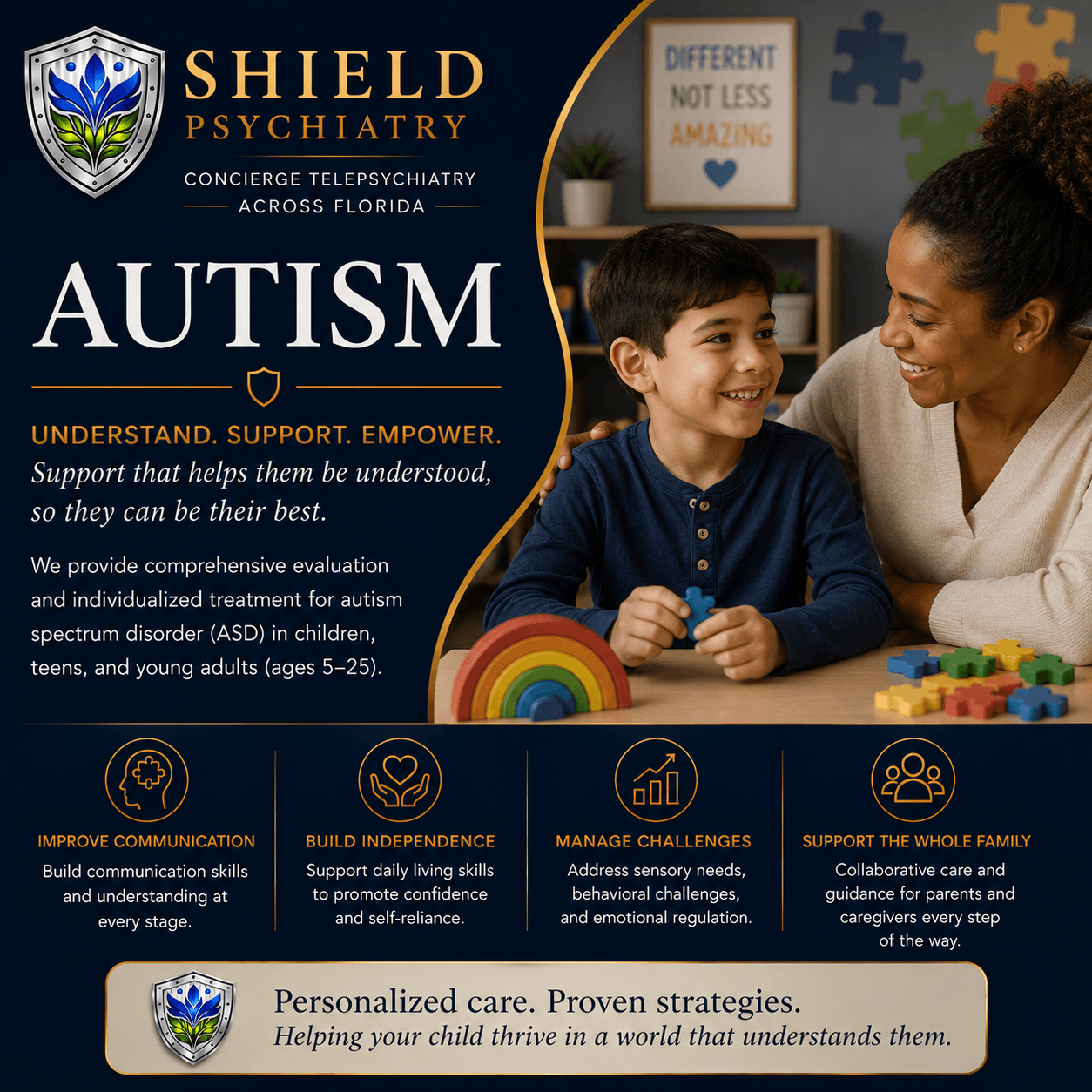
Autism Spectrum: Strengths, Support Needs & Next Steps
Autism Spectrum Disorder is a neurodevelopmental difference that can affect social communication, sensory processing, flexibility, routines, emotional regulation, executive functioning, sleep, and day-to-day independence. Autism is not a character flaw or a parenting failure. Many autistic children, teens, and young adults have powerful strengths, deep interests, pattern recognition, honesty, creativity, and unique ways of solving problems. Support becomes important when sensory overwhelm, anxiety, ADHD, depression, sleep disruption, school stress, meltdowns, shutdowns, irritability, or transition demands begin to interfere with daily functioning.
Important: SHIELD Psychiatry provides autism-related psychiatric support, co-occurring symptom evaluation, parent guidance, school support, care coordination, and medication management when clinically appropriate. Formal standalone autism diagnostic testing may require referral to a psychologist, neuropsychologist, developmental pediatrician, or specialized autism evaluation center.
Who We Support
- Children and teens with autism-related emotional regulation concerns, sensory sensitivities, rigid routines, transitions, meltdowns, shutdowns, or school stress
- Autistic youth with co-occurring ADHD, anxiety, depression, irritability, sleep difficulties, executive function challenges, or social fatigue
- High-masking girls, teens, and young adults who may appear “fine” at school but come home exhausted, overwhelmed, anxious, or emotionally depleted
- Students needing clinical documentation, IEP or 504 support, school collaboration, college accommodation guidance, or transition planning
- Young adults preparing for college, work, independent living, healthcare transition, daily routines, and self-advocacy
- Families seeking neurodivergent-affirming care that reduces shame, supports strengths, and builds practical systems for real life
Autism-Related Psychiatric Support We Provide
- Comprehensive psychiatric evaluation to understand autism-related needs, co-occurring ADHD, anxiety, depression, mood symptoms, sleep concerns, irritability, and functional stress
- Parent coaching for routines, transitions, emotional regulation, sensory-aware responses, meltdown prevention, repair after conflict, and caregiver confidence
- School and college support for IEP, Section 504, accommodations, functional documentation, teacher feedback, and transition planning when clinically appropriate
- Executive function support for organization, task initiation, time awareness, visual systems, follow-through, school demands, and college readiness
- Medication management when clinically appropriate for co-occurring ADHD, anxiety, depression, irritability, mood symptoms, or sleep concerns
- Care coordination with therapists, occupational therapists, speech-language providers, ABA teams, pediatricians, schools, and other supports when helpful and authorized
Strengths & Support Areas: At a Glance
We identify triggers, sensory overload patterns, calming inputs, environmental changes, and routines that reduce distress.
We support authentic communication through scripts, visuals, self-advocacy language, and relationship-centered strategies.
Predictable routines with thoughtful choice points can support flexibility without adding unnecessary overwhelm.
We build task breakdown, time estimation, visual systems, energy-based planning, and follow-through strategies.
What to Expect During Autism-Related Psychiatric Care
- Step 1: Collaborative history, developmental review, strengths inventory, family priorities, and functional goal setting
- Step 2: Review of co-occurring ADHD, anxiety, depression, sleep concerns, irritability, sensory overwhelm, school stress, and emotional regulation needs
- Step 3: Support plan with practical routines, sensory strategies, parent coaching, school documentation, and care coordination when appropriate
- Step 4: Follow-up focused on symptom monitoring, independence building, transition planning, medication review if needed, and adjustments based on real-life functioning
Care may be coordinated with speech therapy, occupational therapy, psychotherapy, ABA, pediatrics, neurology, school teams, and college disability services when clinically helpful and authorized.
Autism-Related Psychiatric Support Across Florida by Telehealth
Autism-related psychiatric support is available by secure telehealth for families across Florida, including Lutz, Tampa, Wesley Chapel, Land O’ Lakes, Odessa, Westchase, Carrollwood, South Tampa, St. Petersburg, Clearwater, Orlando, Winter Park, Windermere, Jacksonville, Miami, Coral Gables, Boca Raton, Weston, Palm Beach, Sarasota, Naples, and surrounding areas.
Frequently Asked Questions
- Is your care neurodivergent-affirming? Yes. The goal is not to “fix” identity. Care focuses on reducing distress, increasing access, supporting strengths, improving function, and helping young people understand and advocate for their needs.
- Do you provide formal autism diagnostic testing? SHIELD Psychiatry provides autism-related psychiatric assessment and support. Formal autism diagnostic testing may require referral to a psychologist, neuropsychologist, developmental pediatrician, or specialized autism evaluation center.
- Can autism occur with ADHD, anxiety, depression, or sleep problems? Yes. Autism can co-occur with ADHD, anxiety, depression, sleep difficulties, irritability, sensory stress, and executive function challenges. Treatment planning should account for the full clinical picture.
- Do you provide school documentation? Yes. When clinically appropriate, we may provide documentation and functional recommendations for IEP, 504, school support, college accommodations, or transition planning. Final eligibility is determined by the school or institution.
- Do you use medication? Medication is considered only when clinically appropriate, often for co-occurring concerns such as ADHD, anxiety, depression, irritability, mood symptoms, or sleep difficulties.
Autism Spectrum Disorder (ASD) FAQ & Resources
-
Autism Spectrum Disorder (ASD) is a lifelong neurodevelopmental condition that affects communication, social skills, and behavior. It exists on a spectrum, meaning individuals experience a wide range of abilities, strengths, and challenges.
-
✔ Social Challenges – Difficulty understanding social cues, maintaining conversations, or making eye contact
✔ Communication Differences – Delayed speech, echolalia (repeating phrases), or preference for nonverbal communication
✔ Repetitive Behaviors – Hand-flapping, rocking, strict routines, or fixations on specific interests
✔ Sensory Sensitivities – Over- or under-reacting to lights, sounds, textures, or touch
✔ Strong Preference for Routine – Discomfort with changes or transitions in daily activities -
Autism is diagnosed through a comprehensive evaluation, which includes:
✔ Developmental history and behavioral assessments
✔ Standardized screening tools and parent/caregiver input
✔ Observations of social, communication, and sensory patternsAt SHIELD Psychiatry, we provide telehealth-based autism screenings to assess and guide families toward appropriate support.
-
There is no single cause of autism, but research suggests that genetics and early brain development play a key role. Autism is not caused by vaccines, parenting styles, or environmental factors.
-
Autism is not a condition that needs to be “cured”, but early intervention and support can improve communication, social skills, and daily functioning. Treatment may include:
✔ Behavioral Therapy (ABA-Informed Strategies) – Helps develop coping skills and adaptive behaviors
✔ Speech & Communication Therapy – Improves verbal and nonverbal communication
✔ Occupational Therapy (OT) – Supports sensory integration and motor skills
✔ Social Skills Training – Teaches social interaction strategies in structured environments
✔ Parent & Caregiver Coaching – Helps families understand and support their child’s needs -
Yes! Many individuals are diagnosed with autism in adulthood, especially those with milder symptoms or those who learned to mask their traits in social settings. If you suspect you may have autism, an evaluation can provide clarity and access to helpful support strategies.
-
✔ Use clear, consistent communication
✔ Respect sensory needs and provide accommodations
✔ Encourage self-expression through preferred communication methods
✔ Offer structured routines to create predictability
✔ Support their strengths and interests -
You can schedule an autism evaluation or behavioral support consultation by filling out our online form or contacting us directly. Our telehealth services make it easy and accessible to receive expert guidance from the comfort of your home.
Autism Resources · Sensory Tools · Parent Support · School Planning
Autism Resources for Parents, Teens & Young Adults
A curated autism resource library for families looking for neurodivergent-affirming support, sensory regulation tools, communication apps, visual schedules, IEP and 504 planning resources, autism and ADHD support, anxiety and sleep guidance, and practical strategies for children, teens, and young adults.
These resources may be helpful for families navigating autism spectrum disorder, sensory processing differences, emotional regulation challenges, social communication needs, executive functioning difficulties, school accommodations, sleep problems, and co-occurring ADHD or anxiety. SHIELD Psychiatry provides autism-related psychiatric support, parent guidance, school coordination, and medication management when clinically appropriate for children, teens, and young adults across Florida by telehealth.
Trusted Autism Organizations, Safety Resources & Family Support Networks
These autism organizations offer family education, local support, service directories, safety resources, advocacy information, and tools for understanding autism across childhood, adolescence, and adulthood.
-
Autism Society
National and local autism resources, education, family support, advocacy tools, and community connections.
-
AANE — Asperger/Autism Network
Groups, coaching, education, and resources for autistic adults, teens, parents, partners, and families.
-
National Autism Association
Autism safety resources, wandering prevention information, family support programs, and crisis-prevention tools.
-
Autism Speaks
Autism toolkits, service directories, family guides, transition resources, and research updates.
Autism-Friendly Tools, Communication Apps & Visual Schedule Supports
Communication apps, AAC tools, visual schedules, emotion coaching tools, and structured planning supports can help reduce frustration, support transitions, build independence, and make routines more predictable.
-
Proloquo2Go
AAC communication app that supports expressive communication for nonspeaking or minimally speaking individuals.
-
Choiceworks
Visual schedules, routine supports, waiting tools, and emotion coaching strategies for daily structure.
-
Floreo VR
Virtual reality lessons designed to practice social, communication, safety, and life skills in structured settings.
-
Visual Schedule Planner
Structured daily planning support for routines, transitions, task organization, and executive functioning.
Autism Books for Parents, Teens, Young Adults & Clinicians
These books offer perspectives on autistic experience, sensory processing differences, neurodiversity, family support, emotional understanding, and strengths-based autism care.
-
The Reason I Jump — Naoki Higashida
First-person insight into nonspeaking autism, sensory experience, communication, and inner life.
-
Uniquely Human — Barry M. Prizant
Strengths-based autism perspective with practical strategies for understanding behavior, regulation, and support needs.
-
The Out-of-Sync Child — Carol Stock Kranowitz
Parent-friendly explanation of sensory processing differences, sensory sensitivities, and sensory-seeking patterns.
-
NeuroTribes — Steve Silberman
History of autism, neurodiversity, advocacy, and the evolving understanding of autistic experience.